Happening Now
Three Cheers For The Molly Wee
May 21, 2026
by Jim Mathews / President & CEO
Only a year after being parachuted in to take over a flailing project and flanked by DOT Secretary Sean Duffy and Deputy DOT Secretary Stephen Bradbury, Andy “Train Daddy” Byford this week announced selection of a Master Developer team to lead the effort to transform NY Penn Station.
Better yet, he said we’ll see actual construction begin within a year.
“Everyone at Amtrak is thrilled to announce Penn Transformation Partners and even more excited that the project is one step closer to having shovels in the ground next year,” said Byford, whose official title is now Special Advisor to the Amtrak Board. “The rapid completion of a rigorous procurement process represents more than just delivering on a highly ambitious milestone; it demonstrates that Amtrak and USDOT are uniquely capable of making this vision a reality.”
Andy, you’re being modest: there are lot of people who would argue that YOU are the only one “uniquely capable” of pulling this program off after decades of delay and a pile of politics unlike anything anywhere else in America. Now, this being New York City, everyone will have commentary, pro and con, and I’ll share my own thoughts below. But first, the details before we move on.
The joint venture of Halmar and Skanska, called Penn Transformation Partners, will build a new station inspired by the original Penn Station that was demolished in the 1960s, bringing back classic design while fitting with the major structures already in place, namely Madison Square Garden and Moynihan Train Hall, USDOT officials said in a press release.
Station plans include a new grand entrance on Eighth Avenue to a new train hall, open concourses, expanded track capacity, new retail locations, better wayfinding and improvements to the existing subterranean structure.
As a New Yorker, and a member of the New York Penn Station Working Advisory Group, or SWAG, I’m overjoyed to see how well Andy has unstuck this perpetually stalled effort, and even more happy to see that they were able to come up with a way to increase NYP’s capacity for trains per hour without physically enlarging the existing station complex beyond the streets it now touches: 31st street to the south and 33rd street to the north, as well as Ninth Ave. to the west and Seventh Ave. to the east.
It’s an especially notable achievement when you consider that our working group was briefed in Fall of 2024 that this was an impossible goal and that, in any case, work would not be able to begin for the better part of a decade.
What a difference 12 months of Byford's leadership made...
Now, the preservationist in me still winces every time I think about the original Pennsylvania Station. It wasn't merely a beautiful building; it was one of the great civic spaces in the world. The destruction of the original station became a cultural touchstone precisely because people realized too late what had been lost. So, I understand completely the impulse to say, "If we're finally rebuilding Penn, shouldn't we do it right?"
But then the operator in me looks at the existing Penn Station and reaches a different conclusion. Hundreds of thousands of people pass through that station every day. They don't need a symbolic debate. They need wider corridors, clearer circulation, less crowding, more daylight, and enough capacity to accommodate future growth. They need a station that works. The Northeast Corridor is responsible for $100 million of U.S. GDP every...single...day. It’s THAT important.
Every previous vision tended to create a constituency large enough to stop it. Move the Garden? The Garden fights. Expand south? The neighborhood fights. Build a replica of the old station? Budget hawks fight. Build a purely functional transportation facility? Preservationists fight. At some point somebody has to produce a plan that enough people dislike only moderately.
The genius of what Byford and the project team seem to be attempting is lowering the political temperature. Not reopening the Madison Square Garden war. Not condemning an entire neighborhood south of the station. Not creating fresh enemies among property owners and elected officials. Instead, trying to assemble a coalition broad enough to actually build something.
Penn Station's greatest enemy has never been any particular design concept. Its greatest enemy has been paralysis.
It’s no secret that I’m pretty impatient these days with the pace of passenger-rail progress. (Go back and re-read my rant about Moon landings taking less time than creating service development plans for new routes.) And that's where I think Andy Byford’s entry into this story really IS the story.
Most infrastructure megaprojects are led either by politicians or architects. Byford's credibility comes from being perceived first as an operator. The nickname "Train Daddy" is funny, but it reflects something real. People believe he actually cares whether passengers can get from Point A to Point B without unnecessary misery. And he proved it during his brief but visibly effective term as President of the New York City Transit Authority. That gives him a degree of trust that many previous Penn Station champions lacked.
What's particularly interesting to me is the through-running component. The through-running debate has often become almost theological in New York rail circles — advocates on one side treating it as the solution to every operational problem, opponents treating it as either impractical or prohibitively expensive. The emerging Penn concept seems to be threading the needle: preserving future opportunities for at least some through-running capability without making the entire project contingent on solving every regional rail governance problem first.
That strikes me as politically intelligent. Build flexibility into the station. Create options for future operators. Don't require unanimous agreement on the future of the entire Northeast Corridor before you improve the passenger experience today.
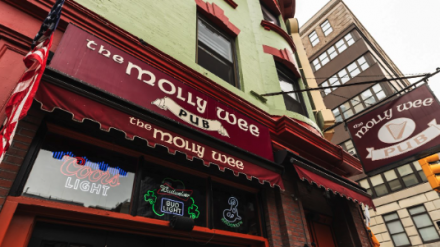
And yes — three cheers for the Molly Wee. As a young college student, I frequented the Molly Wee on Eighth Avenue between 31st and 30th streets. It’s still there, it’s still a neighborhood fixture, and my oldest son and I will still meet up there every once in awhile for a burger.
That may sound like a throwaway line, but I actually think it symbolizes something very important. For decades, Penn-area planning often carried an assumption that neighborhoods existed to serve megaprojects. The message now appears to be: we can improve the station without treating the surrounding community as expendable. That's a healthier approach politically and civically.
The risk, of course, is that ambition outruns execution. You're talking about one of the most complicated transportation facilities in North America, sitting atop active tracks, beneath an arena, surrounded by dense development, with Amtrak, NJ Transit, the MTA, New York City, New York State, the federal government, and countless stakeholders all holding pieces of the puzzle. Nothing about that is simple.
But if you're going to attempt something difficult, I'd rather see a genuinely ambitious vision than another decade of studies explaining why nothing can be done.
As a New Yorker, I suspect history will be kinder to the people who finally improved Penn Station than to the people who spent another twenty years arguing about the perfect way to improve it. The original station is gone. We can't undo that mistake. What we can do is ensure that the next generation inherits something better than the subterranean maze we've been asking passengers to tolerate for the last half-century. And we can raise a glass to the Molly Wee.
"It is an honor to be recognized by the Rail Passengers Association for my efforts to strengthen and expand America’s passenger rail. Golden spikes were once used by railroads to mark the completion of important rail projects, so I am truly grateful to receive the Golden Spike Award as a way to mark the end of a career that I’ve spent fighting to invest in our country’s rail system. As Chair of the Transportation and Infrastructure Committee, it has been my priority to bolster funding for Amtrak, increase and expand routes, look to the future by supporting high-speed projects, and improve safety, culminating in $66 billion in new funding in the Bipartisan infrastructure Law."
Representative Peter DeFazio (OR-04)
March 30, 2022, on receiving the Association's Golden Spike Award for his years of dedication and commitment to passenger rail.
Comments