Happening Now
New Long-Distance Spec: Better Cars Yes, But How About Soul?
May 5, 2026
by Jim Mathews / President & CEO
Some clever person used a FOIA request* to obtain a 1.5 gigabyte copy of Amtrak’s request-for-proposals to U.S. carbuilders for a single-level fleet to replace the bi-level Superliner long-distance fleet. I had a chance yesterday to spend some “quality time” with it, along with its accompanying design visuals, and I’m happy to report I’m seeing an encouraging and coherent philosophy emerging from the package.
It’s thoughtful, serious, and grounded in hard-earned lessons. It addresses the problems riders actually experience today and that I hear about all the time in emails and on social media...the kind of thing I testified about before Congress a few years ago to then-CEO Richard Anderson’s ire. Equipment that breaks, interiors that wear poorly, food service that’s inconsistent, and seats that don’t hold up over long trips, are all addressed here.
It is, in many ways, exactly the document you would want if your goal were to make long-distance service reliable, maintainable, and humane at a baseline level. And certainly that’s something I’ve gone to Congress and called for over and over again.
But the package also reveals something else. For all its strengths, it still struggles to define what makes a long-distance train special. I wrote about that a couple of weeks ago, and I’d encourage you to go back and re-read it.
The opening chapter, a general plan, reads less like a vision document and more like a corrective one. It’s a governance framework designed to impose discipline on a process that has historically lacked that discipline. Reliability, availability, and maintainability are the organizing principles instead of the afterthoughts. Integration is treated as a first-class risk. Interfaces are controlled, documented, validated. Lifecycle costs are foregrounded, not deferred. This is Amtrak saying, plainly, that they aren’t going to let this fleet buy go sideways.
Let’s get it straight: I’m all for that.
Buried deep in Amtrak’s new long-distance equipment specification is a very clear answer to a simple question: how often is this stuff allowed to break? The headline requirement is that each car must run 120,000 miles between service-affecting failures, or very roughly 75 days of continuous operation, or fewer than two major failures per car per year at Amtrak’s projected utilization of 215,000 miles per year.
Individual systems are held to even higher standards: air-conditioning, heating, and air-handling systems are expected to go nearly 400,000 miles between failures, major mechanical systems like trucks and couplers up to 750,000 miles, and lighting up to a million miles. For passengers, I think that’s a great signal that Amtrak doesn’t want these cars to be designed to limp from problem to problem. They’re being designed to run for months, even years, before anything significant goes wrong.
What’s just as important is how Amtrak plans to enforce it. The RFP requires continuous tracking of every failure, formal root-cause analysis, and even a system-wide response if just five percent of the cars show the same defect. And then there’s the big one: an aerospace-like target of 99.99% availability, which translates to less than an hour of downtime per car per year. That’s an extraordinarily high bar, and whether every number is hit remains to be seen...I honestly can’t see it. But the shift is unmistakable. Amtrak is insisting that the carbuilders design and support systems where failures are rare, understood, and steadily eliminated. For passengers, the train should just work.
There are references in that overall plan to customer experience, but it’s mediated, channeled through human factors studies, mockups, and specialist roles. It’s something to be engineered, validated, and approved, not something to be boldly imagined. There is no sweeping statement of what the long-distance experience ought to feel like. Instead, there is a commitment to making sure the system works, and keeps working.
Again, it’s hard to argue against that, per se. We all want decisions likely to last for half a century to be grounded in data, analysis, and careful thought.
The chapter on the carbody specification translates that philosophy into steel. It’s a conservative, durable, single-level platform designed to survive decades of service in the North American environment. It prioritizes interchangeability, ease of repair, and compatibility with existing infrastructure. Importantly, for me at least, it assumes real-world conditions — things like weather, debris, freight interference — and designs accordingly. The train has to carry 72 hours of water. The doors and vestibules have to be snow-proof. And on and on.
Even so, within the boundaries of that conservatism and affordability, I think there are the seeds of something that could be even more grand, more interesting, and more special, and we might have the accommodations for the disability community to thank for that. The design spec creates a continuous, accessible, wide circulation path through the train. Wide gangways, level transitions, ADA-compliant movement throughout. Yes, that’s a compliance move for sure. But it also means, or could mean, that this is a train meant to be experienced horizontally, as a connected whole, for every passenger, all the time.
Some disappointments here, too. What the specification doesn’t seem to do is privilege vertical or panoramic space. There’s no structural commitment to the kind of elevated, expansive environments that once defined long-distance travel.
For me, that means that if a compelling shared space emerges in this fleet, it will have to be created within that horizontal framework, not handed to designers by the structure itself.
The chapter on Interiors decisively raises the bar. I’ll write more on seats separately, since it’s such a hot-button issue. But suffice to say seats are being rethought in response to real complaints, with explicit attention to ergonomics, sleep, and long-duration comfort: “A coach seat should provide initial comfort when first seated and then comfort over the length of passenger travel (minimum of 2 hours and maximum of 72 hours).” And “a human factor specialist shall be involved in all stages of the design, testing, and review process.”
Every passenger is guaranteed a view. Noise and vibration are tightly controlled. Lighting is adjustable and intentional. There is a seriousness here about the lived experience of spending hours, or even days, on a train.
This is great! But nearly every one of these improvements is filtered through the same set of necessary constraints: modularity, cleanability, durability, accessibility. Materials must withstand decades of use. Components must be replaceable quickly. Layouts must be adaptable. The result is a design philosophy that distributes comfort evenly across the train rather than concentrating it in standout spaces.
An allowance for skylight windows is a kind of intriguing opening, but it’s optional, not central. It hints at what might be possible without committing to it.
A lot of folks, I think, will rejoice at the details in the chapter on Food Service, because it confirms a return to the capability, at least, to do real onboard cooking. So all of you out there in the commentariat declaring that you “know” the trains will be all Flex dining, take note: this RFP calls for a full commercial kitchen. It specifically lists griddles, ovens, steam tables, dishwashing capacity (no more plastic!), and substantial storage. It’s not a reheating station. It’s a working galley designed to serve an entire train.
But here, too, it’s embedded in a highly structured system. Commissary provisioning, standardized carts, modular equipment, and strict regulatory compliance define the operating model. This isn’t a return to traditional scratch cooking so much as the creation of a hybrid: centralized supply paired with onboard preparation and finishing. It improves quality and flexibility while preserving consistency and control.
Then you get to the visuals, and the tone really shifts...in a good way.
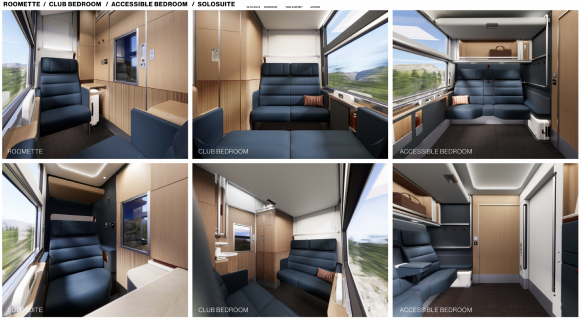
The “Long Distance CX Vision” document (March 2026) is where Amtrak allows itself to gesture toward something more. It looks a lot like the December 2023 document prepared to guide the bi-level Superliner replacement, with many of the same visuals and design elements. But what I really like about it is that the language is about experience. The layouts are framed as a product. And the renderings show a train that is warmer, calmer, and more livable than the RFP’s engineering details alone might suggest.
Coach seating is clearly designed for long stays, not short trips. Privacy wings create subtle personal space without isolating passengers. And they’re trying to design for the entire range of passengers, from the shortest and lightest, to the tallest and heaviest. Lighting is used to shape mood, especially at night.
Premium coach introduces genuine differentiation, with wider seats, a five-degree deeper recline than regular coach, and rotating seat configurations. The idea here is that for many, many trips on long-distance trains there are passengers who aren’t in coach for more than maybe six to eight hours, while others are in coach overnight. So while every seat will be optimized to prioritize sleep, the reality of the way people travel suggests that Premium Coach will be the true overnight coach option.
In the roomettes, windows are centered and maximized, materials are softened, and vertical space is used carefully to avoid a sense of confinement. Windows span high up alongside you.
These aren’t trivial details. I see them as confirmation of the instinct I’ve heard every time I’ve spoken with the Amtrak team working to replace the Superliners, whether they’re customer-focused or design-focused or engineering-focused. These are real professionals, and they really do “get it.” They all show a real understanding that the quality of the experience is important, that people want more than just a functional seat.
But what’s not in this RFP is also telling. There’s still no defining focal space, no architectural centerpiece, no place that clearly says: this is why you take the train. The improvements are real, but they’re distributed. On the plus side, the train feels better everywhere. But on the minus side, it does it without becoming unforgettable anywhere.
Amtrak is solving the problems it knows how to solve and solving them well. Reliability, maintainability, operational realism, accessibility, and baseline comfort are all being addressed in a serious, integrated way. And they’re explicitly looking for equipment that can be designed, built, and put in service soon rather than a decade from now. The result is a train that should work better, feel better, and serve more passengers more consistently, in time to solve today’s real problems.
At the same time, the design stops short of articulating a clear experiential ambition. The train is being defined as a system to be engineered rather than a place to be inhabited. Even where the visuals hint at something more, through lighting, materials, or flexible seating, they remain within a framework that prioritizes consistency over distinction.
That’s the question I tried to raise when I asked last week about what domes really do.
Domes were never just about the view. They were about creating a shared space, a focal point, a reason to get up and move through the train. They made the journey tangible as an experience, not just a passage from one seat to another.
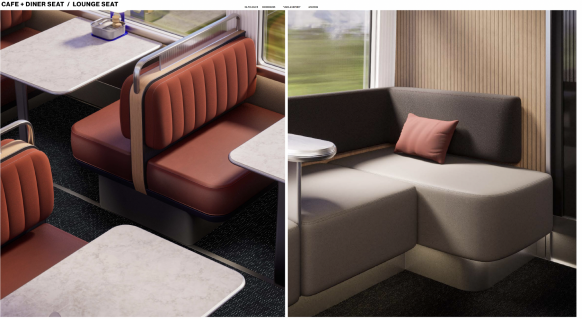
What stands out in both the RFP specification and the design visuals is that Amtrak clearly understands how to make the onboard experience better. There’s a demand for more comfortable seating, improved lighting, better food, and a more accessible, connected train. The opportunity now is to take one more step within that same framework: to ensure that somewhere onboard there’s a space designed not just for sitting or eating, but for being.
The new trains already create a continuous, accessible environment with improved sightlines; shaping part of that space into a true shared area, something closer to a modern lounge than a pass-through café, would build naturally on what’s already there. It’s not about going backward or reviving any single legacy feature. It’s about making sure the next generation of trains has a center of gravity, a place that gives the journey a sense of presence, not just movement.
That’s the opportunity we have at this moment in the solicitation process.
That’s because the really hard work, the unglamorous, necessary work of fixing the obvious problems, has been done here in this RFP. What remains is to build on that foundation and create a space, or spaces, that give the train a center of gravity. This 100 percent is NOT nostalgia for its own sake, but a recognition that shared space isn’t an indulgence or a “land cruise.” It’s part of what makes long-distance rail distinct and worth choosing instead of flying or driving.
Amtrak’s own visuals suggest that instinct is already there. The next step is to follow it through.
-----------
*FOIA stands for Freedom of Information Act, and it’s an initialism that has become an acronym to describe the process ordinary people can use to pry important documents and information out of government-controlled agencies when they don’t publish them on their own.
"Saving the Pennsylvanian (New York-Pittsburgh train) was a local effort but it was tremendously useful to have a national organization [NARP] to call upon for information and support. It was the combination of the local and national groups that made this happen."
Michael Alexander, NARP Council Member
April 6, 2013, at the Harrisburg PA membership meeting of NARP
Comments